Cilly
Berlin AlexanderplatzCilly is Franz Biberkopf’s companion and housemate, and a clear-eyed witness to the damage Reinhold causes by repeatedly taking up with women and then discarding them. When Franz’s loyalty to Reinhold begins to look like participation in that pattern, Cilly confronts him; her protest helps turn his conduct from casual complicity toward an explicit refusal. On April 8, 1928, Franz leaves their room and does not return. Cilly searches for him through the evening, but the narrative separates them without explaining his fate to her.
Identity and Place in the Plot
Cilly enters Franz’s life through Reinhold’s castoffs. She first comes to Franz’s room with a fur collar Reinhold has asked her to deliver. Franz already has boots from Reinhold, too, and he makes a show of them for Cilly, coaxing her into the oversized shoes and hopping along with her as she tries to get away. Their playful encounter turns into a change of household: that night, Cilly arrives to stay, bringing clothes Reinhold had given her, including a nearly new coat and dancing shoes.
The scene establishes the compromised route by which Cilly and Franz become close. Reinhold’s gifts are not simply generous tokens: they arrive alongside his habit of moving on from one woman to another. Franz initially receives both the objects and Cilly with pleasure, and his joke about having a regular supply of new clothes and women makes the arrangement sound almost routine. Cilly’s later objections expose what that easy banter leaves out: women are being treated as transferable possessions, and Franz’s friendship with Reinhold risks making him an accomplice.
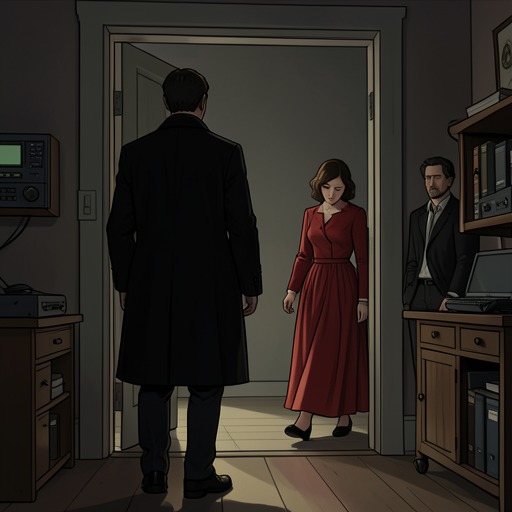
Cilly shares a room and daily life with Franz. She lights the stove, sleeps in the back of the room with her cat, and is present in the intimate domestic scenes that contrast with Franz’s unstable dealings beyond the home. The account does not supply a separate biography for her; her place in the narrative is defined through this household, her knowledge of Reinhold’s behavior, and her efforts to keep Franz from repeating it.
Confronting Reinhold’s Pattern
Cilly’s concern sharpens when Franz tells her he has been talking with Reinhold and raises the possibility of taking over Trude, Reinhold’s current girlfriend. Cilly is furious that Franz has spent hours waiting and then treated her as though the news were harmless. She explains that Reinhold has picked up women repeatedly: she says she was neither his first nor even his eighth, and describes him as someone who spots women in the street and takes them up. She also recalls the change in his appearance and manner when he goes out dancing, a contrast to his brooding, taciturn presence over cups of chicory.
Franz laughs at her account and treats Reinhold’s inability to leave women alone as comic. Cilly hears the danger in that laughter. When Franz mentions Trude again, she shrieks, tears off his jacket, and throws it down; the discarded garment makes her anger physical rather than merely argumentative. Franz asks her to calm down and appeals to his friendship with Reinhold, even reasoning that he should stand by him because Reinhold has begun attending the Salvation Army hall on Dresdner Straße. Cilly’s question about what this means for her brings the conflict back to the relationship they share.
Franz eventually recognizes the contradiction. He says he will not take Trude from Reinhold and that Cilly will stay with him. He puts the boots Reinhold supplied on top of the cupboard and tells Cilly to speak with Trude the next morning, promising that Trude can depend on him. At midday, Cilly brings Trude to their room and tells her plainly that Reinhold is upsetting her and does not care about her. When Trude breaks down, Franz defends Reinhold as his friend but calls his treatment of women cruel and insists that Trude should not be frightened into leaving.
A Different Standard for Friendship
Cilly’s intervention changes the terms on which Franz understands friendship. When Reinhold later says he must get rid of Trude, Franz answers that he will not give up Cilly and urges Reinhold to keep Trude, too. He rejects the prospect of receiving another gift in exchange, telling Reinhold he will buy his own things. His argument is that a woman is a human being, not an animal to be wrapped in affection and then discarded; if Reinhold wants no lasting attachment, he can pay for a sex worker rather than draw women into a relationship and abandon them one after another.
That appeal does not persuade Reinhold. He listens in his detached fashion, drinks his coffee slowly, and says he managed before Franz came along. His withdrawal leaves Franz’s appeal unanswered, but Cilly’s presence has already forced Franz to make his position concrete: he refuses to exchange her for Trude, refuses Reinhold’s material inducements, and offers Trude direct support. The episode shows both the limit and the importance of Cilly’s influence. She cannot make Reinhold change, but she can make Franz see that defending him without qualification would mean accepting the harm he causes.
The Day Franz Disappears
On Sunday, April 8, 1928, Cilly is asleep in the back of the room while Franz sits by the window, listening to bells she cannot hear. When he tells her the bells sounded ominous, she suggests that he may have dreamed them and reminds him there is no Sunday newspaper. Franz remains uneasy and decides to go out to find an evening paper and learn whether anything has happened. Cilly strokes him as they talk, then bids him goodbye without knowing that he will not return.
Franz goes down the four flights of stairs and Cilly never sees him again. She waits in their room until five, then goes out to ask after him in every pub as far as the corner of Prenzlauer Strasse. A landlady tells her that Pums had been asking where Franz lived; Cilly says no one has come to their room. Later, Meck tries to reassure her that Franz will come back, but she continues watching the door and even goes home before returning to the pub. In anger and suspicion, she also looks for Reinhold, wondering whether he persuaded Franz to take another woman. Reinhold’s place is locked, and Trude is absent.
Still searching, Cilly buys a copy of the evening paper on Alexanderplatz and checks whether Franz’s premonition came true. Its reports include a railway accident in Ohio, a clash between communists and a swastika-bearing group, and a major fire in Wilmersdorf; none tells her what has happened to him. She passes the brightly lit Tietz department store and returns toward Prenzlauer Strasse in the melting snow, soaked through and unable to find him. The final revelation is that, while she searches, Franz lies injured in another part of town. Cilly’s search ends in ignorance, not reunion, and the account leaves her relationship with Franz suspended at the moment of his disappearance.
Narrative Role
Cilly gives the story a domestic perspective on the consequences of Reinhold’s serial relationships. Her anger is not abstract moral commentary: it arises from the fur collar, the boots, the proposed transfer of Trude, and the possibility that Franz will treat the women around him as Reinhold does. The objects that first make the arrangement seem attractive become evidence of its cost, and Cilly’s refusal to accept Franz’s easy excuses makes his eventual decision to protect Trude legible as a change in conduct.
Her final scenes echo an earlier pattern of people searching for Franz after he vanishes from their lives, but Cilly’s search unfolds through ordinary places and practical attempts to discover what happened: rooms, pubs, a landlady, a newspaper. She does not know that the danger she fears has already taken hold. The contrast between her vigil and Franz’s unseen injury gives her departure from the main action its force: the person who had pressed him to look after others is left waiting for news that never reaches her in the scene.